After the Intelligent IDE, the Agent Orchestrator
The year 2025 was defined by the AI-augmented IDE. Cursor, Windsurf, GitHub Copilot: each tool offered a single coding agent, more or less capable, integrated into the development interface. The year 2026 marks a transition to something else. The single-agent model is reaching its limits, and a new category of tools is emerging: multi-agent orchestrators.
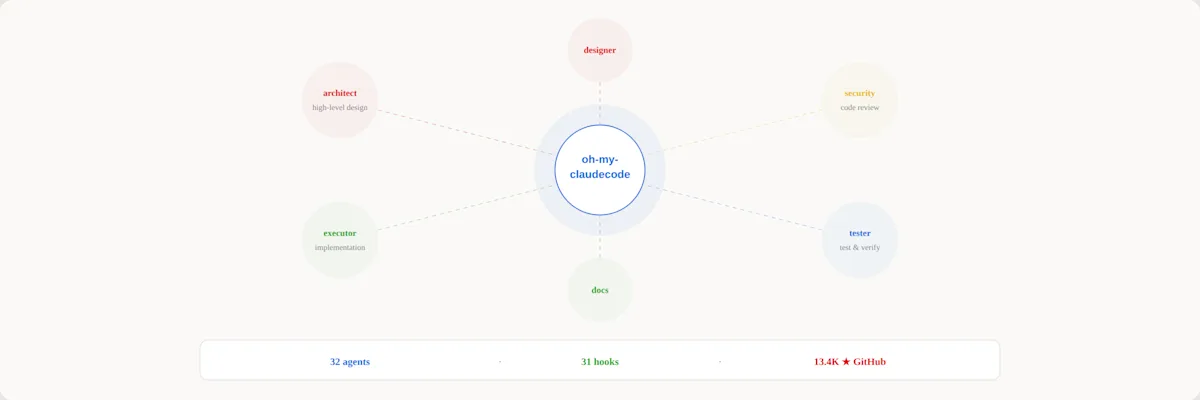
oh-my-claudecode (OMC), an open-source project created by Yeachan Heo, is the most visible representative of this trend. With 13,400 GitHub stars, 877 forks, and 203 releases (including the latest v4.9.1 dated March 24, 2026), it is the most adopted Claude Code plugin in the ecosystem. Its principle: transform Claude Code, Anthropic's terminal agent, into a team of 32 specialized agents collaborating on complex tasks.
For technical agencies already using Claude Code in production, the question is no longer "should we use a coding agent?" but "how do we orchestrate multiple agents to maximize the quality and speed of produced code?"
What oh-my-claudecode Actually Does
OMC installs as a Claude Code plugin with 31 lifecycle hooks that intercept execution at various points. It adds 32 specialized agents organized in three tiers based on the model used: Haiku for simple tasks, Sonnet for medium tasks, and Opus for complex tasks.
The agents cover a broad spectrum of competencies: architect-high for system architecture, executor for implementation, designer for design, qa-tester for testing, security-reviewer for security, scientist-high for data science, and many more. Each agent has a defined role and specific skills.
Execution can follow several modes:
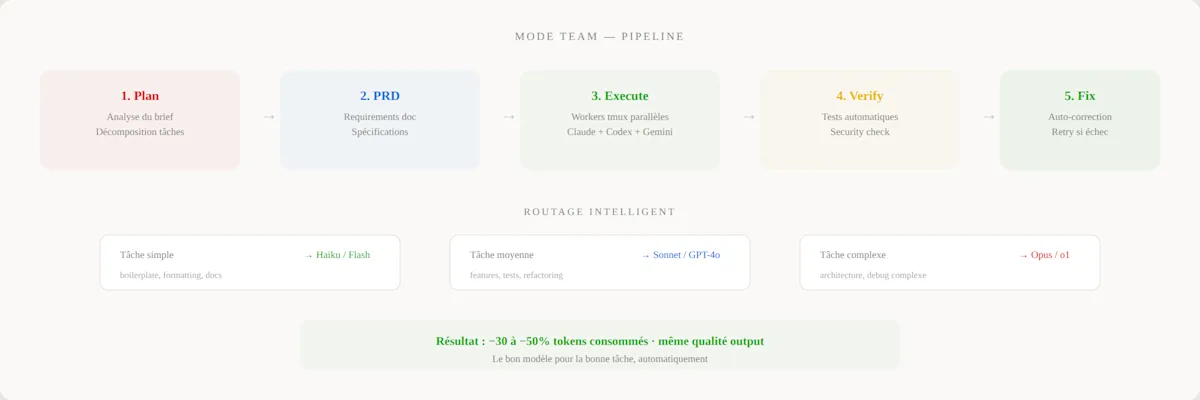
Team mode is the most structured. It follows a canonical five-step pipeline: planning, PRD (Product Requirements Document) writing, execution, verification, and correction. It is the equivalent of a small development team following a defined process.
omc team mode uses tmux to spawn CLI workers that can run Claude, Codex, or Gemini in parallel. This is the maximum productivity mode, with up to 5 concurrent workers.
Autopilot mode and Ralph mode (persistent loops) are designed for long tasks requiring minimal supervision. ccg mode (tri-model advice) consults three different models before making a decision, improving quality on critical architectural choices.
Intelligent routing is a central mechanism: OMC analyzes the complexity of each sub-task and assigns it to the appropriate model. Simple tasks (formatting, renaming, minor fixes) go to low-cost Haiku. Complex tasks (architectural refactoring, concurrency debugging, design patterns) go to Opus. This enables token savings of 30 to 50% according to the project's claims.
Why the Single Agent No Longer Suffices
To understand OMC's value, you need to understand why the single coding agent model is reaching its limits.
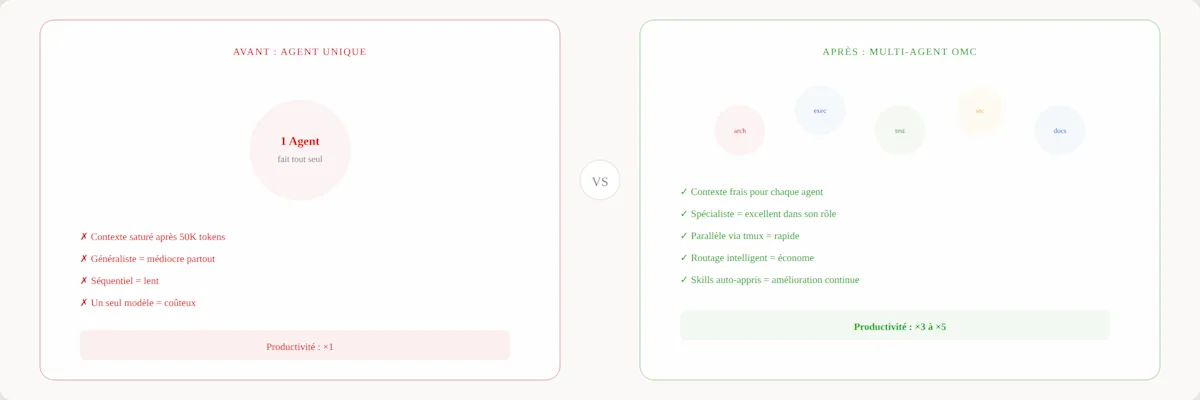
A single agent, however capable, suffers from three fundamental problems when tasks become complex.
The first is the context problem. A single agent that plans, implements, tests, and fixes accumulates an enormous conversation context. After several hundred turns, quality degrades because the model loses track of earlier decisions.
The second is the specialization problem. A generalist agent does everything acceptably but nothing excellently. System architecture, security testing, interface design, and performance optimization are distinct competencies that benefit from specialized prompts and contexts.
The third is the parallelism problem. A single agent is sequential. It cannot simultaneously write code, draft tests, and verify documentation. OMC, with its tmux workers, can.
This transition from mono-agent to multi-agent reflects what the software development industry learned decades ago: specialized teams produce better code than isolated developers. OMC transposes this principle to the world of AI agents.
The Context of the Claude Code Explosion
OMC adoption cannot be understood outside the broader context of the Claude Code explosion. According to SemiAnalysis, Claude Code now accounts for 4% of GitHub commits, a staggering figure for a tool barely over a year old. Anthropic, which raised $30 billion in February 2026, reports that Claude Code contributes significantly to a $2.5 billion ARR.
Claude Code itself is evolving rapidly. Version 4.1.7 introduced experimental Agent Teams, a native agent teams feature. But this feature is still limited, and this is precisely the gap OMC fills. OMC offers 32 agents where native Claude provides a handful, lifecycle hooks where Claude offers only basic interactions, and multi-model compatibility (Gemini, Codex) where Claude is limited to its own models.
For agencies billing Claude Code subscriptions to their developers (Pro at $20/month, Max at $100-200/month), OMC is a productivity multiplier that can justify the Max plan cost by increasing throughput per developer.
Practical Implications for Agency Workflows
For a technical agency, OMC changes how development projects can be executed.
The first change concerns code reviews. Instead of waiting for a senior developer to manually review junior code, the security-reviewer agent can perform a first automated pass, the qa-tester agent can verify test coverage, and the architect-high agent can validate architectural compliance. The senior then intervenes on points requiring human judgment.
The second change concerns prototyping. Team mode, with its plan-prd-exec-verify-fix pipeline, can produce a functional prototype from a brief in hours rather than days. For client pitch phases where speed is critical, this is a measurable competitive advantage.
The third change concerns maintenance and refactoring. Repetitive tasks (dependency migration, pattern updates, style standardization) can be delegated to Autopilot mode with minimal supervision. OMC's auto-learning skill, which learns from recurring patterns and stores them in .omc/skills/, progressively improves the quality of these automated tasks.
The fourth change concerns documentation. The documentation-dedicated agent can maintain READMEs, API docs, and changelogs automatically after each development session, work that nobody likes to do and everyone neglects.
Limitations to Know Before Adoption
OMC is not without constraints, and agencies must evaluate them carefully.
The first constraint is Claude subscription dependency. OMC is a Claude Code plugin, meaning it requires an active Anthropic subscription. Max plans at $100-200/month per developer represent a significant cost for a team of 10+ developers.
The second constraint is setup complexity. Installation requires tmux, configuration of hooks and agents, and an understanding of Claude Code's inner workings. This is not a "one-click" tool. Onboarding time for a developer unfamiliar with Claude Code can be several hours.
The third constraint is the absence of independent benchmarks. Claims of 3-5x productivity gains and 30-50% token savings come from the project itself. No independent evaluation has yet confirmed these figures. Actual results likely vary by project type and task complexity.
The fourth constraint is project maturity. Despite 13,400 stars and 203 releases, OMC remains a community open-source project. Bugs, breaking changes, and incompatibilities with new Claude Code versions are risks to anticipate.
The Strategic Question: Build or Buy Orchestration?
Beyond OMC itself, the real strategic question for agencies is who will standardize multi-agent orchestration for software development.
Three trajectories are possible. The first is that Anthropic natively integrates OMC's features into Claude Code, making the plugin obsolete. Experimental Agent Teams suggest this is the direction, but the timeline is uncertain.
The second is that projects like OMC become de facto community standards, in the manner of oh-my-zsh for terminals. OMC's rapid adoption (13,400 stars in a few months) supports this path.
The third is that a commercial tool (Cursor Teams, Windsurf Enterprise, or a newcomer) offers a packaged and supported multi-agent orchestration solution, with the stability guarantees enterprises require.
For agencies, the recommendation is to experiment with OMC on internal projects to understand the benefits and constraints of multi-agent orchestration, without making it a critical dependency in client production. The ecosystem is still too young to bet your infrastructure on, but too promising to ignore.
A practical aspect worth highlighting is OMC's auto-learned skills system. The .omc/skills/ directory stores recurring patterns discovered by agents across sessions. When an agent solves a problem specific to your codebase (a naming convention, an architecture pattern, a testing method), it can save it as a reusable skill. Over time, the skills set becomes an organizational memory for your team, progressively improving the quality of automated interventions. For an agency with recurring projects and specific internal conventions, this automatic knowledge capitalization is a significant value multiplier.
Monitoring is another strong point. OMC's HUD (Head-Up Display) allows real-time tracking of each agent's activity, tokens consumed, and routing decisions. Notifications via Telegram and Discord allow supervising long sessions without staying in front of the screen. For a tech lead overseeing multiple developers using OMC simultaneously, this visibility is essential for optimizing costs and quality.
The broader question that OMC raises is not about a specific plugin but about the direction of software development itself. If the trajectory of AI coding tools continues from single agents to orchestrated teams, then the competency that will matter most in agencies is not writing code but designing agent workflows. The developers who thrive in this new paradigm will be those who can decompose complex projects into agent-executable tasks, define quality gates between agent steps, and know when to intervene with human judgment. OMC is the first tool that makes this workflow tangible and testable for any team willing to invest a few hours in setup.
Got a project in mind?
SEO, prospecting, B2B data, AI agents, websites or design: 30 minutes to talk it through.
A 30-minute call with the team. Final price set together.