Why the 3-Minute Duration Is Not the Real Story
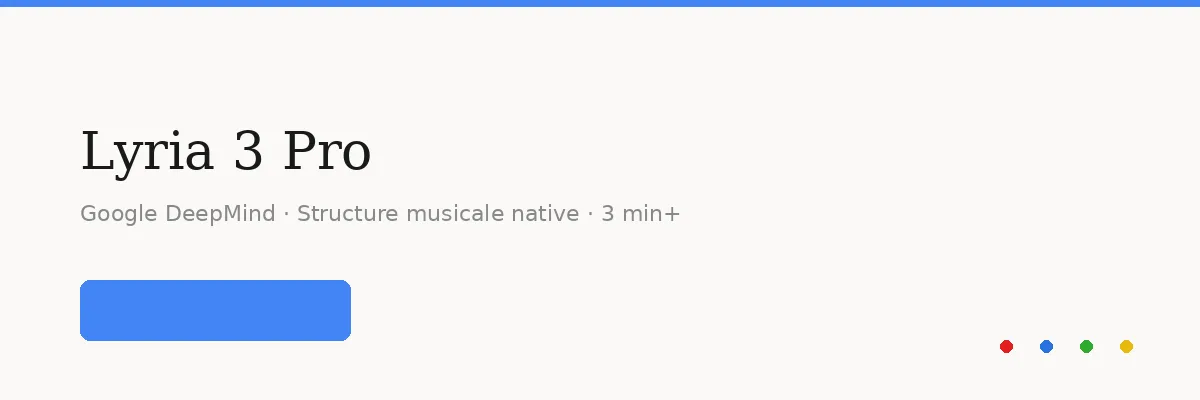
On March 25, 2026, Google DeepMind announced Lyria 3 Pro, its most advanced music generation model. Most press headlines focused on the jump from 30 seconds (Lyria 3, released a month earlier) to a maximum of 3 minutes. This is real progress, but it is not what should capture the attention of creative agencies.
The real innovation in Lyria 3 Pro lies elsewhere. It is the first consumer-facing music generation model that allows controlling the structure of a track through the prompt: intros, verses, choruses, bridges, outros. You are no longer requesting a "piece of music." You are describing a sonic architecture and the model builds it.
For an agency that produces video content, podcasts, audiovisual marketing, or that guides clients on content strategies, this distinction between "generating sound" and "composing a structure" fundamentally changes the possible applications.
The Technical Architecture of Lyria 3 Pro
Lyria 3 Pro uses latent diffusion applied to temporal audio latents, an architecture shared with Lyria 3 but enriched with improved musical composition understanding for complex prompts. The model was trained on permissible YouTube/Google data and partner contributions, using TPUs with JAX/ML Pathways. The exact parameter count has not been disclosed.
The model accepts text and image inputs, generates vocals and lyrics, and offers BPM and intensity controls. One of the most important features for professionals is multilingual support. All outputs are watermarked with SynthID, Google's AI detection system, meaning every generated track is traceable.
Technical specifications are as follows: up to 184 seconds (approximately 3 minutes) of music, 44.1 kHz sample rate, 192 kbps bitrate, MP3 output, under the model ID lyria-3-pro-preview.
Feature | Lyria 3 | Lyria 3 Pro |
|---|---|---|
Maximum duration | 30 seconds | 184 seconds (~3 min) |
Structural control | No | Yes (intro, verse, chorus, bridge) |
Vocals and lyrics | Limited | Yes |
BPM control | No | Yes |
SynthID | Yes | Yes |
API | No | Yes (Vertex AI, Gemini API) |
The Integration Ecosystem: From Gemini to Vertex AI
One of the major competitive advantages of Lyria 3 Pro is its native integration into the Google ecosystem. The model is available in the Gemini app (for paid subscribers), Google Vids, Vertex AI (public preview), Google AI Studio, the Gemini API, and ProducerAI.
Usage limits in the Gemini app vary by subscription: 10 full tracks per day for AI Plus subscribers, 20 for Pro, and 50 for Ultra. On Vertex AI, the quota is 10 requests per minute in preview.
For agencies, API access via Vertex AI and the Gemini API is the most relevant pathway. It allows integrating music generation directly into automated content production pipelines. A workflow that generates a marketing video, a script, and its custom soundtrack in a single processing chain is no longer science fiction.
What Structural Control Changes for Content Production
Before Lyria 3 Pro, AI music generation essentially produced "moods." You described a genre and a feeling, and the model generated a more or less coherent sound block. Useful for a YouTube video background, but unusable for a TV commercial, a brand jingle, or a podcast soundtrack.
The structural control in Lyria 3 Pro allows specifying in the prompt the progression of the track: start with a soft piano intro, transition to a verse with vocals and guitar, build intensity on the chorus, come back down on a bridge, and conclude. The model understands these musical concepts and translates them into sonic structure.
For a creative agency, this opens concrete use cases that were previously impossible.
The first use case is custom music production for advertising. Instead of browsing royalty-free music libraries to find a track that "roughly fits," you can generate a track whose structure precisely follows your spot's edit. The chorus buildup coincides with the visual high point, the intro matches the logo reveal, the conclusion aligns with the packshot.
The second use case is podcast soundtracks. A branded podcast can have a unique musical identity generated by Lyria 3 Pro: an intro jingle, transitions between segments, and an outro, all coherent in tone and BPM.
The third use case is rapid prototyping for client presentations. Before commissioning an original composition from a musician, an agency can generate several structured musical variations to accompany a video storyboard. The client chooses the direction, and final work can be done by a human composer based on this mock-up.
The Rights Question: SynthID and Google's Approach
A topic that agencies must absolutely master before recommending Lyria 3 Pro to their clients is the question of rights. Google has adopted a unique approach in the AI-generated music industry.
First, all tracks are watermarked with SynthID, meaning they are detectable as AI-generated content. This is a constraint but also a protection: traceability allows proving the origin of content in case of dispute.
Second, the model does not allow imitation of existing artists' styles or voices. Unlike some competitors that have faced lawsuits for this reason, Google has built guardrails that prevent generating content mimicking identifiable artists.
Third, the training data comes from authorized sources: YouTube/Google data and partner contributions. Safety measures include dataset filtering, fine-tuning, RLHF, output filters, and SynthID watermarking.
For agencies, this approach is a double-edged sword. It offers superior legal security but reduces creative flexibility. You will not be able to generate a track "in the style of" a specific artist, which is precisely the type of brief that clients love to give.
How Lyria 3 Pro Competes Against Suno and Udio
The competitive landscape of AI music is dense. Suno already offers 4-minute tracks with a studio editor at $10 per month. Udio excels in rapid iteration and is community-driven. Stable Audio, Mureka, and Eleven Music round out the field.
Criterion | Lyria 3 Pro | Suno | Udio |
|---|---|---|---|
Max duration | 3 min | 4 min | Variable |
Price | Included with Gemini (~$20/mo) | $10/mo | Variable |
API available | Yes (Vertex AI) | Yes | Yes |
Structural control | Yes | Limited | No |
AI watermarking | SynthID (mandatory) | No | No |
Artist imitation | Blocked | Possible | Possible |
Enterprise integration | Google Cloud, Vertex AI | No | No |
Lyria 3 Pro distinguishes itself on three axes. Integration into the Google Cloud and Vertex AI ecosystem is a massive advantage for companies already using this infrastructure. Legal security via SynthID and anti-imitation protections is a strong argument for risk-averse clients. And API access via Vertex AI enables integration into automated production pipelines that competitors do not facilitate as smoothly.
However, Suno remains superior in maximum duration (4 minutes versus 3) and creative flexibility. Gemini's rate limits (10-50 tracks per day depending on subscription) can also be constraining for intensive production.
Practical Recommendations for Creative Agencies
For agencies considering integrating AI music into their workflows, Lyria 3 Pro deserves serious attention but does not replace strategic thinking about use cases.
The recommended use is producing ambient and background music for corporate video content, presentations, branded podcasts, and web advertising. Audio quality (44.1 kHz, high fidelity) and structural control make these uses viable in production.
The use to avoid is music as a final product for large-scale premium campaigns. SynthID watermarking means the content is detectable as AI, which can pose image problems for certain brands.
The approach we recommend at Bridgers is a hybrid workflow: use Lyria 3 Pro for prototyping and mock-ups, then have a human composer finalize tracks that require a premium touch. The AI-generated track serves as artistic direction, not as the final deliverable.
Agencies producing large volumes of content (social media video, weekly podcasts, recurring client presentations) have the most to gain. The reduction in music sourcing time from several hours to a few minutes per project adds up quickly.
AI-generated music is no longer a gimmick. With Lyria 3 Pro, it becomes a serious production tool for agencies that know where and how to use it. The key is understanding that structure is the real differentiator, not duration.
One dimension that agencies should monitor closely is the evolving competitive response. Suno has been facing legal challenges over copyright and artist imitation, which could reshape the competitive landscape in Google's favor. If regulatory pressure increases on AI music generators that allow style imitation, Lyria 3 Pro's strict guardrails become a competitive advantage rather than a limitation. Agencies that build workflows around compliant tools today will not need to restructure when regulations tighten.
The enterprise integration path through Vertex AI also opens a door that most competitors cannot match. For agencies building comprehensive content production pipelines that already use Google Cloud for video processing, translation, or data analytics, adding music generation as another API call in the same ecosystem reduces integration complexity dramatically. The ability to generate a video with Veo, add voiceover with text-to-speech, and compose a custom soundtrack with Lyria 3 Pro, all within the same Google Cloud project, is a workflow that no competitor can currently replicate end to end.
Got a project in mind?
SEO, prospecting, B2B data, AI agents, websites or design: 30 minutes to talk it through.
A 30-minute call with the team. Final price set together.