At Bridgers, we design and build digital solutions for our clients: websites, applications, growth strategies, and increasingly, AI integrations. When Perplexity announced Computer in late February, then unveiled Personal Computer at the Ask 2026 developer conference on March 11, we had to take a close look. As an agency that advises clients on technology adoption, we need honest answers, not hype. After several days of evaluation and cross-referencing early tester feedback, here is our candid assessment: the promise is massive, but early feedback reveals gaps that matter for anyone considering this tool in a professional context.
Perplexity Computer: 20 AI Models, One Goal
On February 27, 2026, Perplexity officially launched Computer, a system it describes as a "general-purpose digital worker." The pitch is bold: you describe an outcome in natural language, and Computer breaks it down into tasks and subtasks, assigns them to specialized sub-agents, and delivers the final result. Research, design, code, deployment, all handled in a single, coherent workflow.
Aravind Srinivas tweet Perplexity Computer launch
What sets Computer apart from competitors is its multi-model architecture. Rather than relying on a single language model as most AI assistants do, the system orchestrates roughly 20 different models: Claude Opus 4.6 for complex reasoning, Google Gemini for deep research and sub-agent creation, Nano Banana for image generation, Veo 3.1 for video, xAI Grok for lightweight speed tasks, and OpenAI GPT-5.2 for long-context recall and broad search. Plus around 14 other specialized models.
This "best model per task" approach is compelling on paper, and Perplexity's internal numbers seem to back it up. In January 2025, 90% of Perplexity's queries were routed to just two models. By December 2025, no single model accounted for more than 25% of traffic. The shift toward dynamic, intelligent routing signals that the multi-model approach is not just marketing, but an operational reality.
The system runs in an isolated cloud sandbox (2 vCPU, 8 GB RAM, Linux) with a real filesystem, a real browser, and over 400 claimed integrations: Slack, GitHub, Google Drive, Notion, Salesforce, and more. It operates asynchronously, meaning you can kick off a task and step away while it works, sometimes for hours, sometimes for days on complex projects. Persistent memory across sessions is an additional asset: Computer remembers your previous projects and can pick up where it left off. Context compaction technology keeps long sessions coherent even as they stretch on.
Personal Computer: Your Mac mini Becomes an AI Agent
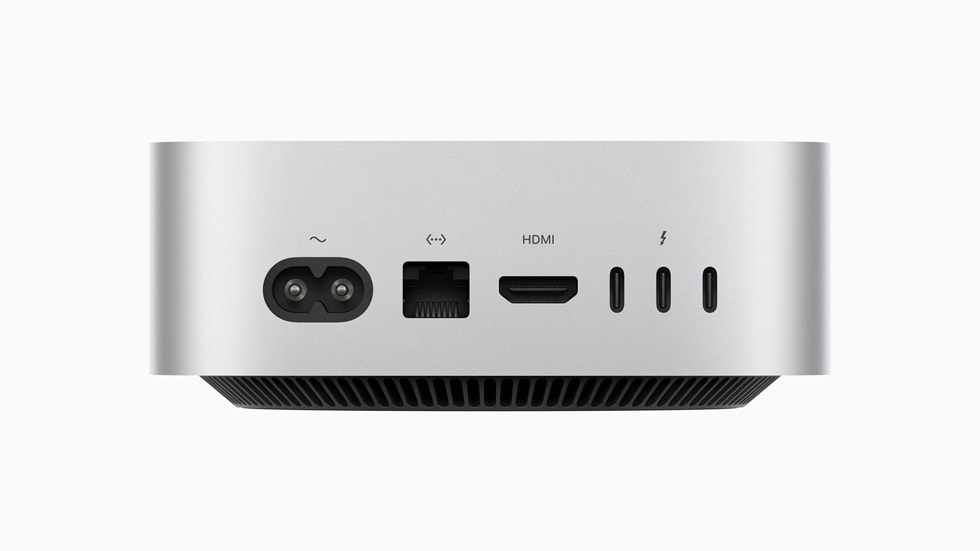
This was arguably the most striking announcement at Ask 2026 on March 11. Personal Computer turns a Mac mini into a permanent AI agent that runs 24/7 without requiring your presence. This is no longer an assistant you summon; it is a collaborator that works continuously.
Perplexity tweet Personal Computer announcement
The concept merges your local files, applications, and sessions with the cloud-based power of Computer. The agent can monitor triggers (an incoming email, a dashboard alert, a competitor's price change), execute proactive tasks without waiting for your prompt, and be controlled remotely from any device. Aravind Srinivas, Perplexity's CEO, captures the philosophy: "A traditional operating system takes instructions; an AI operating system takes objectives."
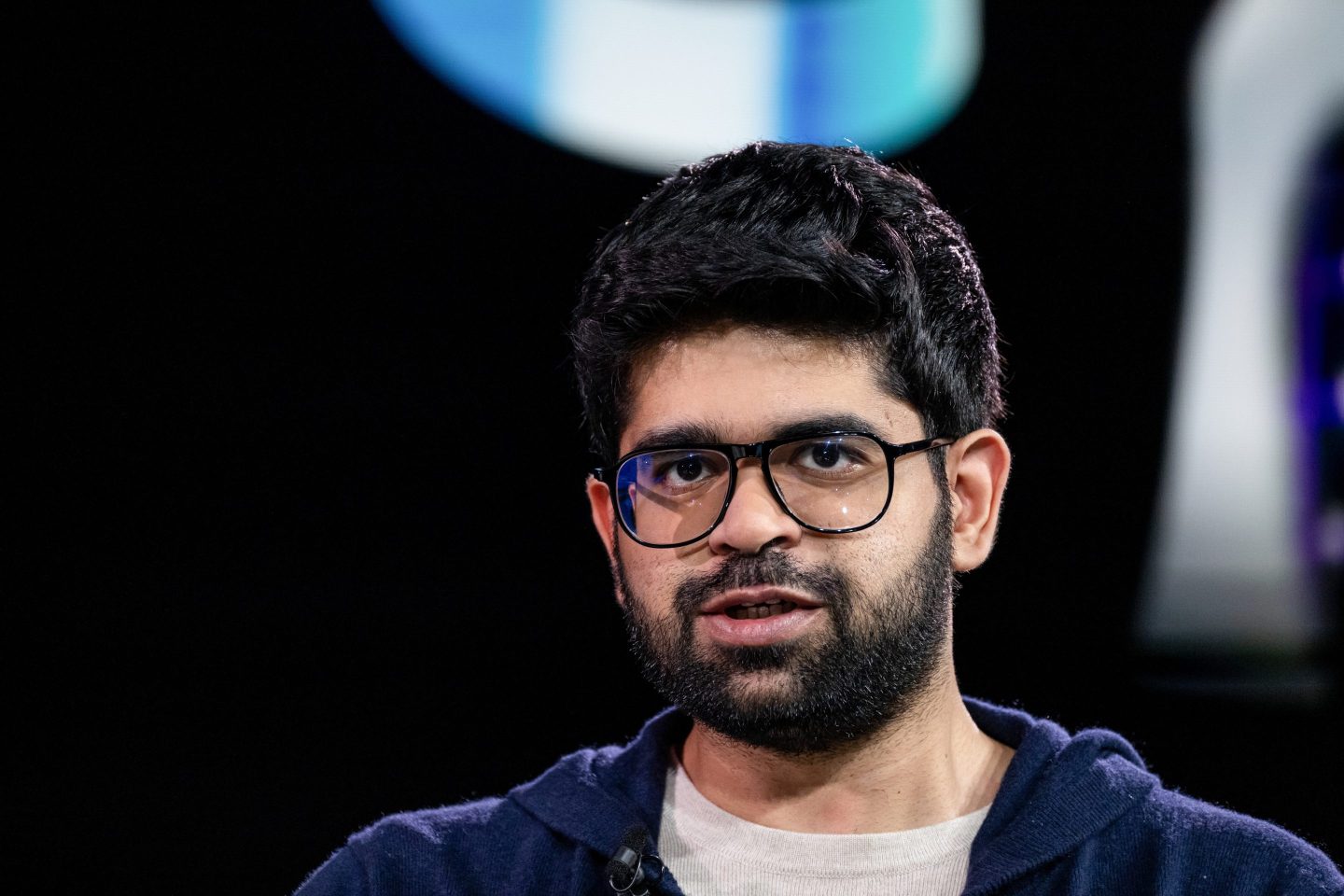
Aravind Srinivas tweet Personal Computer
On the security front, Perplexity promises explicit approval for sensitive actions, a full audit trail, and a kill switch. For now, Personal Computer is limited to Max subscribers ($200/month) and Mac-only. A waitlist is open, with no announced timeline for Windows or Linux support.
For an agency like Bridgers, the question is obvious: is this the future of the digital workspace? Imagine an agent that runs continuously, monitoring Google Ads campaign performance, generating weekly performance reports on schedule, preparing client briefs automatically from CRM data, or detecting metric anomalies before the client notices. The potential is considerable. But we remain cautious for a simple reason: an "always-on" agent that continuously consumes credits is also a runaway cost risk if the guardrails are not robust. And as we will show, the current guardrails leave something to be desired.
Computer for Enterprise: Slack, Snowflake, and CRM Connected
Perplexity is not hiding its enterprise ambitions. The Enterprise offering arrives with the certifications and features expected by CIOs and compliance teams: SOC 2 Type II compliance, SAML SSO, SCIM provisioning, and detailed audit logs. Each session runs inside an isolated Firecracker microVM, the same technology powering AWS Lambda, ensuring complete isolation between sessions and between users.
The real selling point is connectivity. Computer for Enterprise plugs into Snowflake, Salesforce, HubSpot, Datadog, and SharePoint. Custom connectors are available through the Model Context Protocol (MCP), an open standard that lets developers build their own integration bridges. The Slack integration is particularly noteworthy from an adoption standpoint: you can query @computer directly in your channels and threads, as if it were a colleague responding in real time.
Perplexity also provides ready-made workflow templates for common enterprise use cases: legal contract review, financial auditing, sales preparation, and customer support. Pricing is usage-based, with an organization-wide credit pool that allows teams to share resources.
The offering also includes an expanded finance data layer: over 40 live data sources (SEC filings, FactSet, S&P Global, Coinbase, LSEG, Quartr), the ability to build interactive dashboards and Excel models, all without additional licensing. Perplexity reports that 75% of its users already ask finance-related questions monthly.
For our clients who already run on a Slack-Salesforce-Google ecosystem, the idea of plugging in a cross-functional AI agent that can navigate between these platforms is appealing. But as we will detail below, the reality of these connectors is less polished than the marketing suggests.
Is $200/Month Worth It?
Perplexity Computer requires a Max subscription at $200 per month (or $2,000 per year). The subscription includes 10,000 monthly credits, with a temporary launch bonus of 35,000 additional credits. Extra credits can be purchased, and a default spending cap of $200/month is in place, extendable up to $2,000. Auto-refill is available, but it is a double-edged sword if you are not monitoring consumption closely.
To give a sense of scale: a text briefing costs roughly 15 cents. But tasks involving video, complex coding, or multiple deployments consume significantly more. One Reddit user reported burning through 15,000 credits, 50% above their monthly allocation, in a single 40-minute session. Others noted that the pricing model pushes users toward the Enterprise tier, creating a funnel effect that some find aggressive.
Aravind Srinivas tweet $225,000 in tools replaced
Aravind Srinivas' tweet claiming that Computer replaced $225,000 per year in marketing tools over a single weekend is undeniably enticing. But it needs context. For an agency managing dozens of clients with established workflows, replacing specialized tools with a generalist agent is not a straightforward decision. The question is not just direct cost, but reliability at scale, predictability of results, the learning curve for each team member, and the ability to guarantee consistent quality.
For a freelancer or small team already paying several hundred dollars monthly across fragmented SaaS tools (Ahrefs, Semrush, Canva, Notion, etc.), the value proposition may genuinely make sense if Computer can replace even a portion of those tools. For an agency like Bridgers, with established processes and quality commitments to clients, the math is more nuanced and requires months of evaluation, not a weekend.
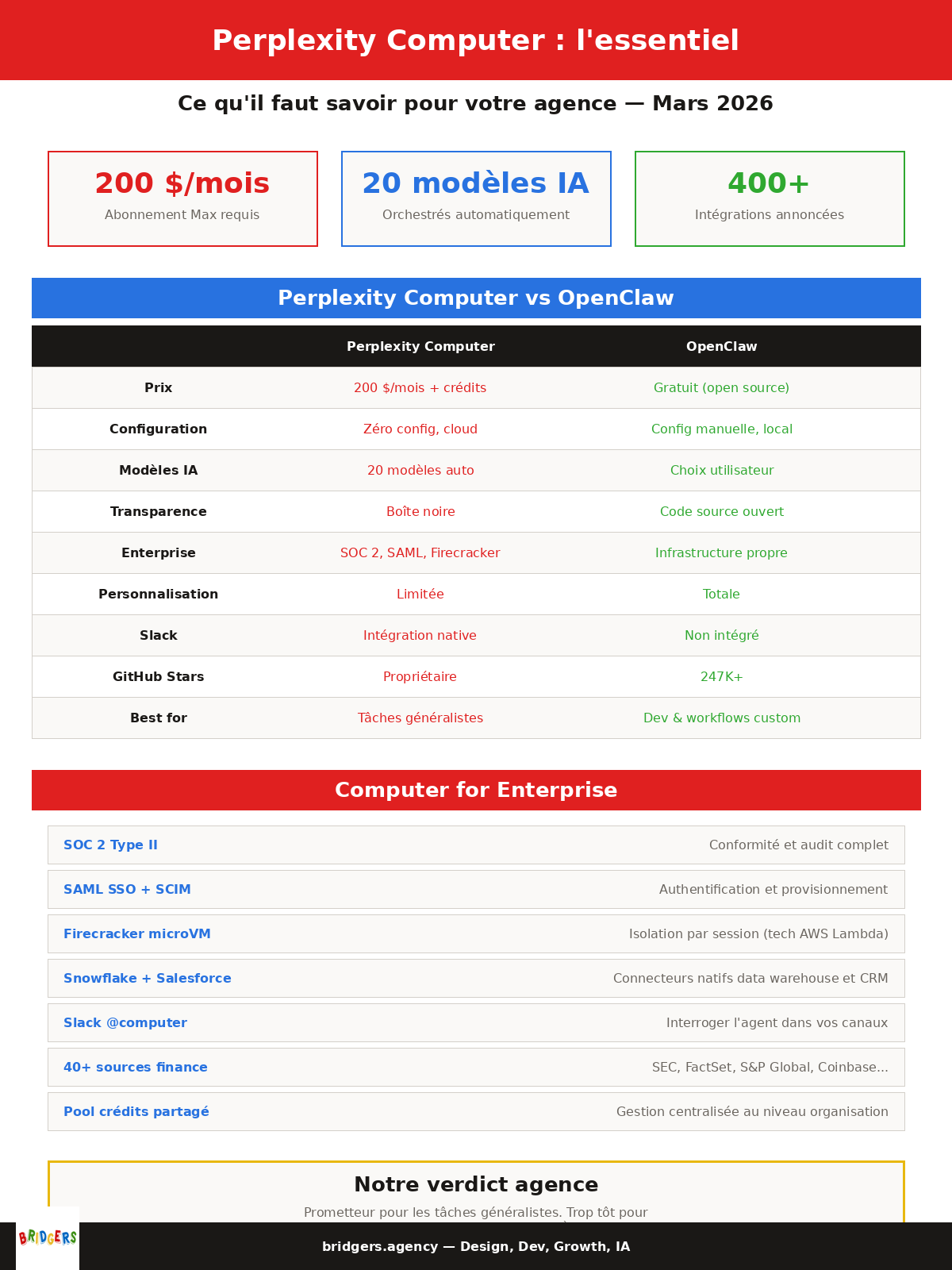
OpenClaw vs Perplexity Computer: Two Philosophies
The most relevant comparison today pits Perplexity Computer against OpenClaw, the open-source project with 247,000 GitHub stars. Both tools share a similar goal, automating complex workflows via AI, but their approaches diverge fundamentally on almost every axis.
Criteria | Perplexity Computer | OpenClaw |
|---|---|---|
Setup | Zero configuration, managed cloud | Heavy customization required |
Cost | $200/month + usage-based credits | Free, open source (247K GitHub stars) |
Environment | Isolated cloud sandbox (Linux) | Local, on user's machine |
Models | 20 models orchestrated automatically | User selects and configures their model |
Customization | Limited, no persistent config | Full control, custom MCP servers |
Transparency | Black box, no live preview | Open source, complete execution control |
Enterprise security | SOC 2 Type II, SAML SSO, isolated microVMs | Depends on user's own infrastructure |
Dependencies | Competitor APIs (Anthropic, OpenAI, Google) | No imposed external dependencies |
Best for | Generalist tasks, non-technical users | Developers, custom workflows |
Perplexity's philosophy is the turnkey service: describe what you want, and the system handles the rest. OpenClaw takes the opposite approach: you configure every detail, choose your models, and control execution at every step. For a technical agency like Bridgers, OpenClaw offers a degree of control and transparency that Computer does not yet match. But for non-technical clients who want to delegate tasks to AI without touching code, Computer has a clear accessibility and onboarding advantage.
The structural risk for Perplexity deserves emphasis: the system depends on API access to models from its direct competitors (Anthropic, OpenAI, Google). If any of these providers restricts access, raises prices, or deprecates an API, the entire architecture is affected. Managing the price changes, updates, and deprecations of 19 different models is a non-trivial operational challenge. OpenClaw, as an open-source project, does not carry this structural dependency. This is a point that any business considering building critical processes on Perplexity Computer should keep in mind.
Real Limitations From Early Testers
This is where the enthusiasm needs to be tempered by facts. The detailed review published by Builder.io in early March is particularly instructive, and it aligns with feedback we gathered from other testers and specialized forums.
Connectors Are Unstable
In theory, over 400 integrations. In practice, the few connectors tested by Builder.io had significant issues. Vercel's OAuth authentication expired every session, forcing constant reconnection. The Ahrefs connector only displayed backlinks with no access to the tool's other features. GitHub required a workaround via a personal access token instead of the native integration. As the Builder.io review summarizes: "In practice, the few I tested had significant issues." For an agency that needs reliable connectors to automate client workflows, this level of maturity is insufficient.
The Black Box Problem
No live preview, no hot reloading. When Computer works inside its sandbox, you cannot see what is happening in real time. No way to inspect code being generated, no way to intervene quickly if the agent takes a wrong turn. For a developer accustomed to rapid iteration with immediate visual feedback, this is frustrating and counterproductive. Builder.io reports that it took two days to produce a single-page website, largely because of these slow feedback loops. Two days for one page, when an experienced developer can build it in a few hours with conventional tools.
Silent Failures and Runaway Costs
This is perhaps the most concerning point for professional use. npm install commands that fail silently without alerting the user. An agent that burns through 10,000 credits on broken Vercel deployments, over and over, without ever flagging the error. A Reddit user who exceeded their monthly allocation by 50% in under an hour with no clear warning. For an agency that bills clients on predictable budgets and validated estimates, this lack of cost control is simply a dealbreaker in its current state.
No Environment Customization
No persistent configuration, no secrets management, no custom MCP servers. Every session essentially starts from scratch. For agency workflows that require reproducible development environments with environment variables, API keys, and project-specific configurations per client, this is a major limitation. The agent also makes surprising technical choices: Builder.io reports that Computer used the GitHub API directly instead of the standard clone/branch/push workflow, making the code harder to maintain.
What This Means for Digital Agencies
After this thorough analysis, what do we concretely recommend to our clients at Bridgers? Honestly: wait and watch, while keeping a close eye on developments.
What Works Today
Computer's strength lies in generalist tasks that do not require fine-grained execution control. Deep multi-source research with synthesis, structured report generation, presentation creation, marketing content drafting, data analysis with visualization. For a marketing director who needs a detailed competitive benchmark in two hours rather than two days, Computer can deliver impressive results. The cloud sandbox consistency eliminates "works on my machine" issues. The multi-agent orchestration is genuinely impressive in its ability to parallelize subtasks and combine the strengths of different models.
Dmitry Shevelenko, Perplexity's COO, stated that the introduction of Computer internally was "the single biggest productivity unlock in our entire history as a company." On Slack, he added that the internal prototype "took off in a way that no other internal prototype ever did before." For internal use at a tech company like Perplexity, that is credible. But translating that productivity into the context of a multi-client agency with strict quality requirements and validation processes at every step is a different story.
What Does Not Work Yet for Agencies
Development workflows are too slow and too opaque to replace an existing CI/CD pipeline. Connectors are not reliable enough for critical production integrations. Cost management is insufficient for client projects with fixed budgets and contractual commitments. The lack of environment customization prevents use in multi-project production pipelines. And the credit-based pricing model with variable consumption makes budget forecasting difficult.
Our Concrete Recommendation
For agencies: evaluate Computer on low-risk, low-stakes tasks. Competitive research, brainstorming, first-draft content generation, exploratory data analysis. Do not integrate it into critical production workflows for now. Monitor updates to connectors and cost management over the coming months.
For enterprise clients: if you already spend tens of thousands of dollars annually on fragmented SaaS tools and your team has a non-technical profile, Computer can start consolidating certain research, reporting, and content creation workflows. But keep a close eye on your credit consumption and set strict caps from day one.
For developers: OpenClaw remains a better choice for code and technical automation workflows today. Full execution control, source code transparency, and zero cost outweigh Computer's ease of access, especially when Computer's feedback loops turn a few-hour task into a two-day project.
Personal Computer is the most intriguing piece of the puzzle, and the one that could change the game in the medium term. A permanent, local agent that merges cloud and machine, capable of working while you sleep, monitoring your metrics, and preparing tomorrow's meetings. If Perplexity manages to resolve the connector reliability, execution transparency, and cost predictability issues identified with Computer, Personal Computer could genuinely redefine the digital workspace for agencies and enterprises alike. But we are not there yet.
At Bridgers, we will continue to test and evaluate these tools as they evolve. Perplexity's annualized revenue (roughly $148 million as of mid-2025, with a target of $656 million by end of 2026) shows the company has the resources to back its ambitions. The promise of agentic AI is real, and Computer is its most complete demonstration to date. But its execution in a demanding professional context remains to be proven.